- Just Sendin It
- Posts
- Is it still worth freelancing given today’s climate?
Is it still worth freelancing given today’s climate?
Here are things to consider.

Tina Sendin
May 07, 2024
The state of freelancing is the most competitive I’ve seen since I started in 2018.
In my last post, I shared a no-holds-barred, unadulterated view of the freelancing landscape based on my experience as a full-time freelance writer and various accounts from other freelancers.
I shared this on LinkedIn, and it somehow hit a nerve. Many say it’s so true it hurts.


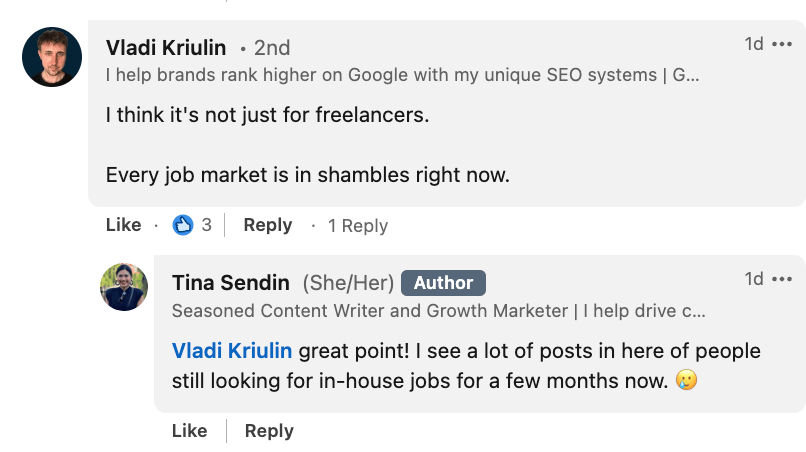
Some also say that the grim reality of landing a new gig doesn’t just apply to freelancing but to the job market in general.
This leaves us with the million-dollar question:
Should you still freelance given the current landscape?
Here are a few points I mulled over finding answers myself:
1. Freelancing is a rollercoaster. No, really.
I knew all along that freelancing is very different from having a 9-5.
Not that it’s less stable; layoffs have taught us that having an office job does NOT guarantee you’re out of the woods.
What I mean by freelancing being different is that it’s a constant up and down of workflow, finances, emotions, crippling anxiety, and rewarding thoughts.
It’s something I never experienced working for an employer — thanks to these three things:
Schedule and flexibility
If you’ve worked in corporate America (or wherever you are), your brain is likely wired to start hustling at 8 or 9 am and end at 5 or 6 pm, even later through the night if you work 60-hour weeks.
Freelancing means you own your schedule.
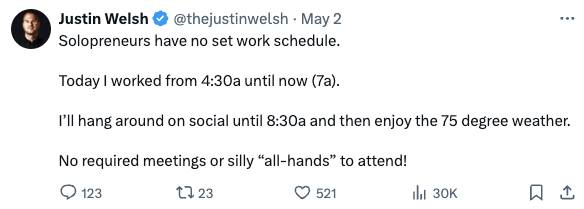
When I started full-time freelancing last year, I’d work before I saw the first glimmer of sun shining through my office window. After hours of deep focus and state of flow, I’d go to the park, read a book at the beach, or catch up with people for coffee at 11 AM.
The wiring from years of working a 9-5 made me uncomfortable, as if I was doing something wrong or illegal.
Then, I’d remind myself that this is exactly why I chose to freelance. I’d instantly feel better.
Entrepreneurial mindset
Having the flexibility also means you’re still accountable to clients and yourself.
If you decide to tweak your workday schedule to work 4 hours a day or 3 days a week, you must ensure that you deliver client work at the highest standards. (Read: not cramming them a day before the deadline.)
To me, the rudest awakening was when I realized that my workload is now commensurate to the money coming into my bank account. If my deliverables and to-do lists are short, my bank will get fewer dings that month.
If I choose to read a book at the beach, that means letting go of hours promoting my services or writing more articles for a client.
Opportunity cost is a bitch. But it’s all a matter of balance.
As I’ll discuss shortly, whatever you choose to do depends on your priorities and which season you are in your life right now.
Cashflow and workload
This is the most common reason why people decide to go for (or avoid) freelancing.
A 9-5 means monthly (or weekly, maybe fortnightly) payments to your payroll account.
With freelancing, aside from varying amounts of cash you get monthly, you’ll also have different payment terms.
Some clients will pay you once a month, others whenever you complete a project. You need to stay on top of cash flow and invoices.
If you’re considering freelancing, ask yourself: Are you okay with monthly variable income? Are you willing to do the admin stuff like invoices and follow-ups? (For the record, these are my least favorite parts of freelancing.)
Also, depending on how busy or quiet your month will be, you have to be open to the possibility of having minimal or zero work at all.
Sometimes, when I go into a relatively quieter month, I’ll go full steam with marketing my services.
If and when the universe favors me, my pitches and job applications will land me more writing gigs — oftentimes to the point of having too much work!
I don’t know why, but I find my workload at either end of the spectrum — really quiet or extremely busy. Seldom in between!
(Give me busy than crickets, anytime of the day…)
All this to say, freelancers who thrive can deal with (1) both the dry spell and extremely busy days and (2) oftentimes crippling anxiety around what the next few months will look like.
No two months are alike, unless all your clients are retainers.
2. How do you see freelancing?
Ask yourself: What does freelancing mean to you?
Do you want to freelance in between jobs?
Did you get laid off and want to freelance in the interim?
Do you have bills to pay and need an additional source of income?
Do you want to gain experience, learn about tools, stay on top of trends in the industry, and learn a new skill?
Do you want to expand your career and venture into other industries?
Have you always wanted to own your business or work for yourself?
Are you experiencing burnout and want a more flexible lifestyle?
Are you curious and want to see if it’s something you can try on the side, and maybe do full-time later on?
Your answer to these questions will help you decide whether to go for freelancing.
3. It boils down to your risk appetite and season in your life.
This is something related to #2.
Where are you in your life right now? What are your top priorities?
Are you starting a career and thinking of working for yourself?
You may likely have a higher risk appetite if you’re young and have fewer responsibilities and family obligations (e.g., no mortgage or fewer mouths to feed.)
You may be open to experimentation and trying out different niches. You may be okay with constant changes around freelancing.
Freelancing could be rewarding because it could give you character-building experiences and set the foundations for soft skills you’ll need to pursue freelancing (or a shift to corporate) in the future.
Is anyone relying on you for financial support?
Do you have kids and a mortgage to pay for?
Do you have multiple incomes in your household that can back your variable freelance cash flow month-on-month?
How about healthcare and retirement? Will freelancing cover these for you? And again, do you have other sources of income that can?

If you see freelancing as an increased earning potential, gauge if you have enough capacity and time.
Are you willing to let go of some family time for an additional source of income?
Do you have a young family with a newborn? Or an empty nester with extra time in your hands?
As I’ll discuss shortly, freelancing is more than just writing or providing services for a client.
It’s equal parts delivering a service, running a business, and marketing — essentially doing the hard things.
4. Freelancing is HARD work.
Freelancing is not easy. There, I said it.
It is NOT just delivering services for clients. It is a business.
When I first went full-time with freelancing, I thought all I’d be doing was writing.
Later on, I learned that I also needed to allot more time on the business side of things like invoicing and following up on payments (I only had one client I had to do this. I’m very lucky the rest of my clientele are organized.)
To successfully run a freelance business, you must manage your time and balance client work with everything admin. That means blocking time for writing, marketing, developing contracts and proposals, and sending invoices.
I use my Fridays to work on my monthly Profit-and-Loss statements, invoicing, and contracts. I also block my afternoons for marketing and dedicate my early mornings to deep-focused client work.
ALSO…
In such a competitive environment, client acquisitions play the biggest role in staying afloat.
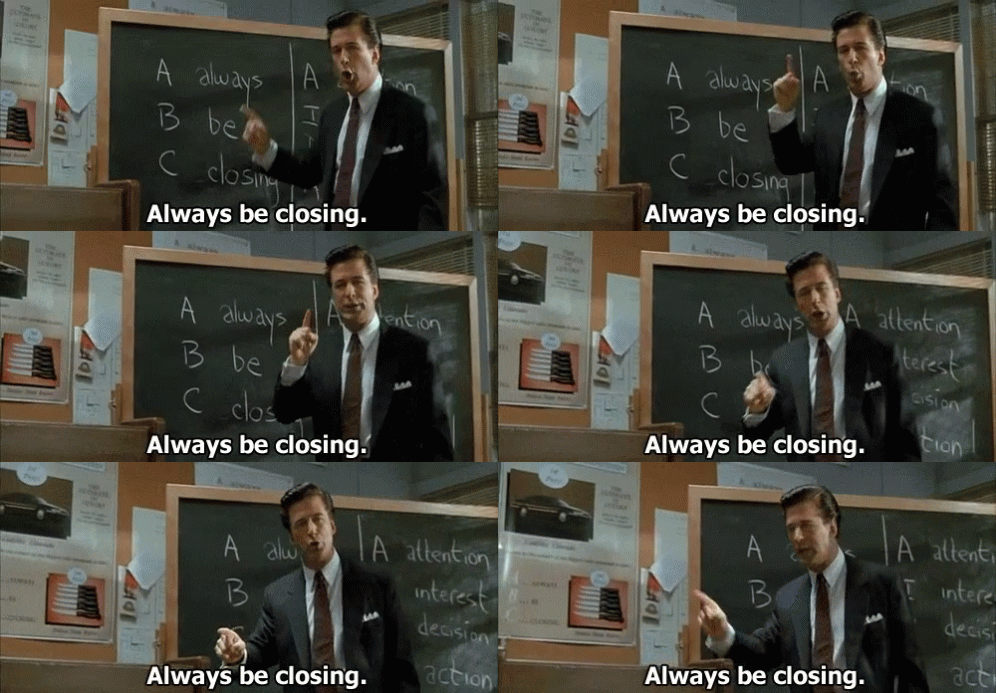
I made the mistake of being complacent with selling my services because I was 70% into my bandwidth. When a client dropped off, I needed a replacement… stat.
So always be selling!
Freelancing requires nonstop marketing. You need to establish a strong differentiation against other freelancers.
It’s a continuous process of selling your services and building your brand. That means:
Continuous pitching and sending Letters of Intent, even if you have existing clients
Active networking and presence in many communities (both online and offline). Be part of Slack channels, Facebook groups, LinkedIn communities, co-working spaces, and virtual coffee chats. Attend social mixers, industry conferences, and trade shows
Regular posts on channels where your prospective clients spend most of their time, i.e., LinkedIn, Twitter, Slack
Pitching guest posts and by-lined articles in major websites and publications to build your brand, reputation, and positioning
Building a website or landing page that showcases your work (sample articles) and client testimonials. I built mine on WordPress ages ago primarily to learn the platform and website development. Still, it’s helped me so much in demonstrating my experience and my clients’ experience working with me
Work with other freelancers in terms of content development, i.e., guesting in their podcasts, creating joint posts on Instagram, engaging and sharing their content on LinkedIn
5. You can always experiment and see what works for you.
Say you have a 9-to-5 and want to try freelancing. I’d say go for it.
If you think it won’t take away the focus and ability to deliver high-quality work in your day job — and you’re willing to spend more hours (either before/after work or on weekends) — then absolutely do it.
Otherwise, maybe freelancing isn’t a good fit now, and that’s okay too.
If you’ve been freelancing for a while and want to make it a full-time gig, look into your current financial state, clientele, willingness to work harder, and how long you’ve been doing it.
If you think it’s time, why not take the plunge?
And if you eventually find that it’s not quite working for you and the current climate may not be the best time to go full-time, there’s no shame in going in-house or pursuing other things.
We make decisions based on what’s right for us at the time.
When should you take the big leap and go full-time?
Last year, I found myself taking the big leap. I left my day job and decided to go all in with freelancing.
To me, it came to a point when it was almost a crime not to even try doing it because of how much work I had been (and will potentially be) getting.
These are the mad signs that told me it was time:
I had a steady flow of clients for the last two years.
I was servicing 3-5 clients at a time.
I could land clients with consistent outreach, and the pace at which I was getting new gigs fit my risk appetite.
I had ample personal savings and an emergency fund.
I was comfortable with networking and promoting my services online.
I’d invested in tools that help me broaden my visibility and deliver services more quickly.
I’d found my niche and positioning.
Every career path has its own “hard,” and I preferred the challenges of freelancing over the “what-ifs” for the rest of my life.
I was certain this was something I wanted to do every day. (There’s no point leaving your day job for freelancing if you’ll resent doing it.)
What now?
Solopreneurship and the anti-hustle culture are upon us, and these things will blow up in the near future — if they haven’t yet.
This tells me three things:
Starting now means you’ll have an early mover’s advantage. You’ll have a longer time to build your business and learn the soft skills to set yourself apart from others.
If you can survive (and thrive) in this climate, you’ll be unstoppable! Remember COVID? Most of the ventures that started four years ago are thriving and growing now, no matter how bleak and grim things were. If you thrive in this condition, it can only get easier.
You can always pivot. If you try to start or continue freelancing and realize it’s not working for you, you can always change direction. I’ve loved every moment of freelancing full-time, but with mortgages to pay, I find myself looking for (and landing) an in-house writing job. Nothing’s set in stone.
There’s no good or bad time to start something. Only something to gain by making a move.
So make that move.